

RAG Systems & AI Knowledge Bases
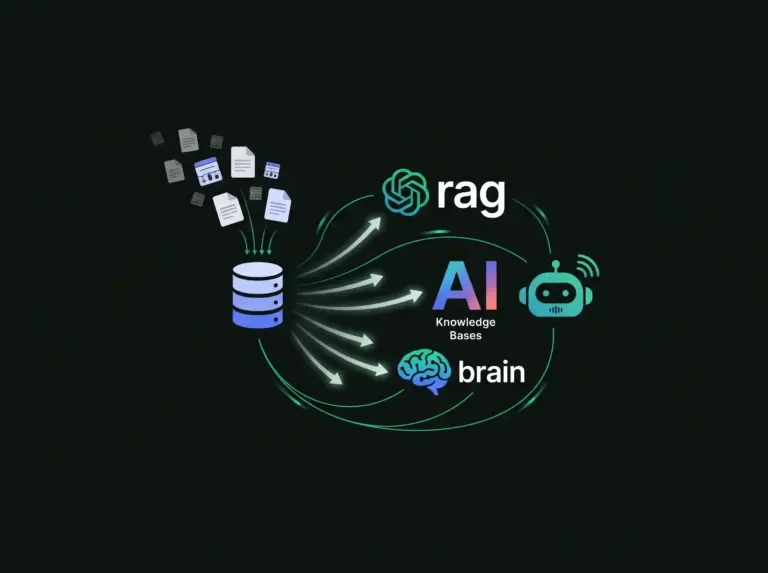
RAG is how you get ChatGPT-quality answers grounded in your own documents — with citations, without retraining a model, and without your knowledge base leaking into anyone’s training data.
I build production RAG pipelines end to end: document ingestion and chunking tuned to your content (contracts chunk differently than support docs), embeddings and vector storage (pgvector, Pinecone, or fully self-hosted), retrieval with reranking for precision, and answer generation that always cites its sources. Deployed as an internal knowledge assistant, a customer-facing support brain, or an API your products call — self-hosted when privacy demands it.
What's Included:
Payment Security
Why Choose My RAG Systems & AI Knowledge Bases Services?
I deliver exceptional results with a focus on quality, performance, and client satisfaction.
Accurate Answers
AI responses are grounded in your actual data — not hallucinations. Every answer comes with source citations.
Your Data, Your AI
Train on your documents, SOPs, product manuals, and knowledge base. The AI becomes your domain expert.
Always Current
Update the knowledge base as your content changes. The AI always has access to the latest information.
Scalable
Handle thousands of documents and hundreds of concurrent queries without performance degradation.
Steps for completing your project
After purchasing the project, send requirements so I can start the project.
Delivery time starts when I receive requirements from you.
I work on your project following the steps below.
Revisions may occur after the delivery date.
Requirements & Data Audit
I review your documents, data sources, and use cases to design the optimal RAG architecture — chunking strategy, embedding model, and retrieval approach.
Infrastructure Setup
Setting up the vector database, configuring the embedding pipeline, and establishing the document ingestion workflow.
RAG Pipeline Development
Building the retrieval chain — query processing, semantic search, context assembly, and LLM prompt engineering for accurate, cited responses.
Interface & Integration
Creating the user interface (chat UI, API endpoint, or integration with your existing app) and connecting it to the RAG pipeline.
Evaluation & Optimization
Testing with real queries, measuring retrieval accuracy, tuning chunking/retrieval parameters, and optimizing for your specific use case.
Review the work, release payment, and leave feedback.
What if I'm not happy with the work?Frequently Asked Questions
Common questions about this service
PDFs, Word docs, web pages, Markdown, CSVs, databases, and more. I build custom ingestion pipelines for any document format your organization uses.
ChatGPT only knows its training data. A RAG system searches YOUR documents and provides answers with citations. It doesn't hallucinate because responses are grounded in your actual content.
Yes, the entire stack can run on your own infrastructure using open-source models (Llama, Mistral) and self-hosted vector databases. No data leaves your servers.
Modern RAG systems easily handle tens of thousands of documents. I've built systems indexing 10,000+ documents with sub-second query response times. Scalability is built into the architecture.
The pipeline watches your sources — a document library, wiki, or CMS — and re-indexes what changed on a schedule or a webhook, so updated policies replace stale ones in the vector store automatically. Deleted documents leave the index too, which matters as much as additions. Because every answer cites its source passages, an outdated answer is traceable to the exact file that needs attention rather than being a mystery.
Other Services You May Need
AI Chatbot Development
Intelligent chatbots powered by ChatGPT, Claude, or custom AI models.
Custom AI Agents
Specialized AI agents that perform complex tasks and make intelligent decisions.
Machine Learning Solutions
Custom ML models for predictions, recommendations, and data analysis.
Ready to Get Started?
Let's discuss your project requirements and create something amazing together.
